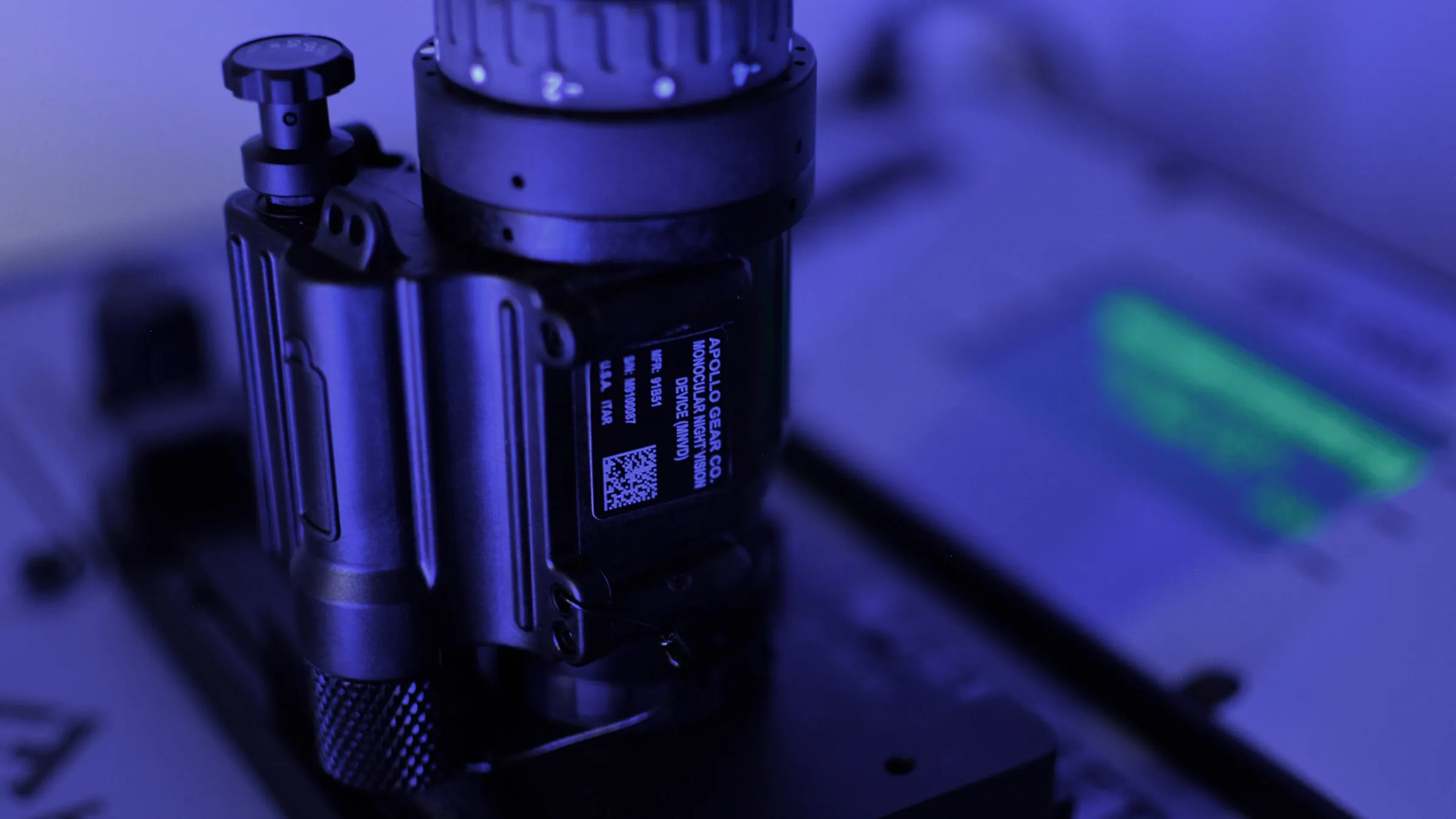
Market insight and buying experience
Learning the market as a buyer
In late 2020, I found a small community of people who were deeply interested in night vision. Some used it professionally. Others were hunters, ranchers, amateur astronomers, or technical hobbyists. I belonged to the last group. I was fascinated by the technology and trying to understand what to buy.
The research was harder than it should have been. The retail market was concentrated among a small group of sellers. Lead times were long, product information was inconsistent, and customers often committed thousands of dollars without seeing the exact unit they would receive.
I began calling retailers, component suppliers, builders, and people in the user community. Before I sold a device, I bought the parts for a PVS-14 and built the monocular myself. I wanted to understand the product from the inside before asking anyone else to trust me with a purchase.
Rebuilding the buying experience
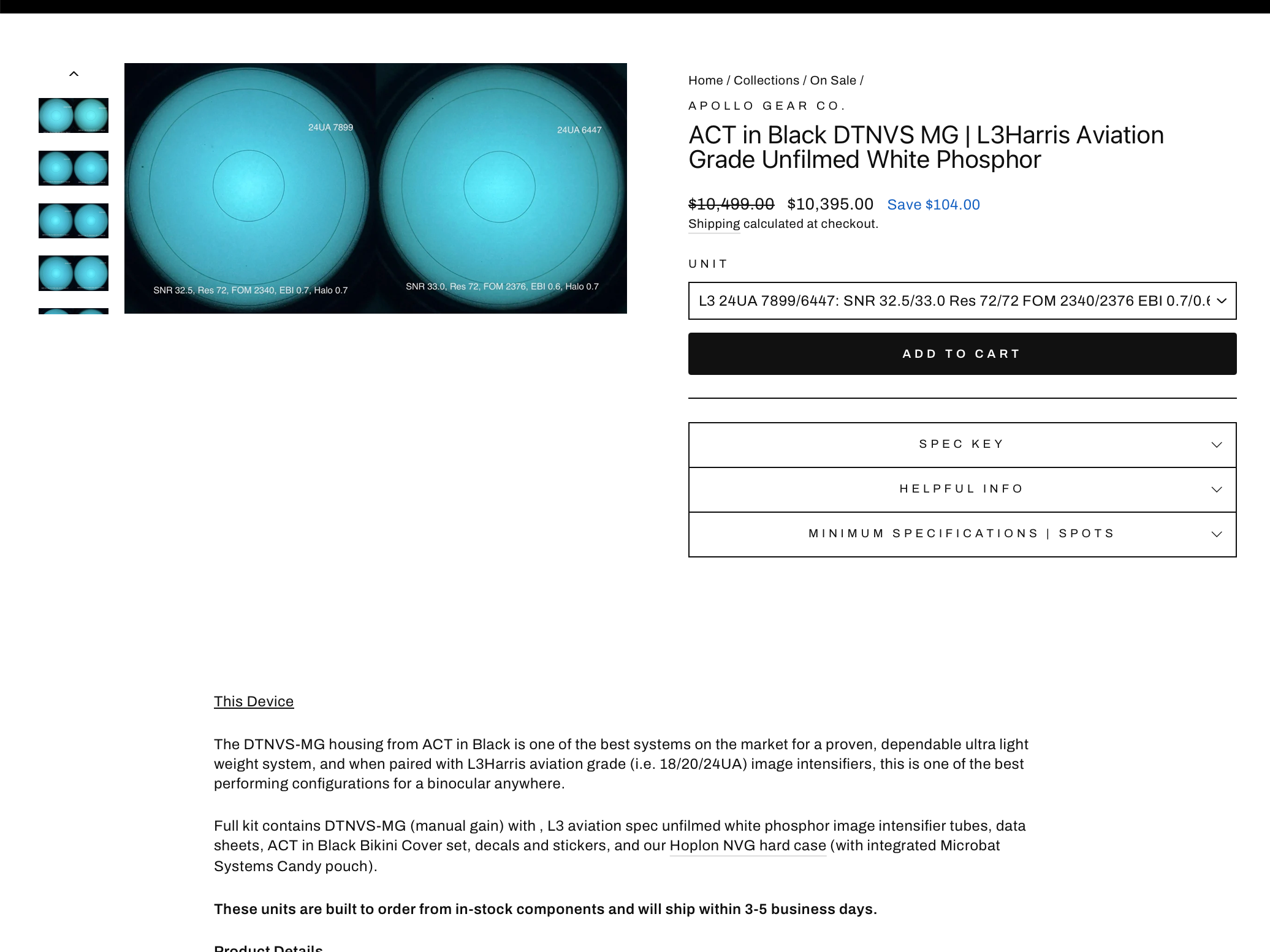
Apollo began as a reseller. I used my own capital to hold finished devices so customers did not have to wait for an open-ended build. For every unit, I published the actual specifications and photographed the view through the intensifier tube, including visible spots or blemishes.
The principle was straightforward: a customer should know what was arriving before paying for it.
Night vision is expensive and initially difficult to understand, so a good sale often required a long conversation, a candid recommendation, fast and careful shipping, and a call afterward to make sure everything worked as expected.
 Expand
Validating demand through a manufacturing partner
Growing through customer referrals
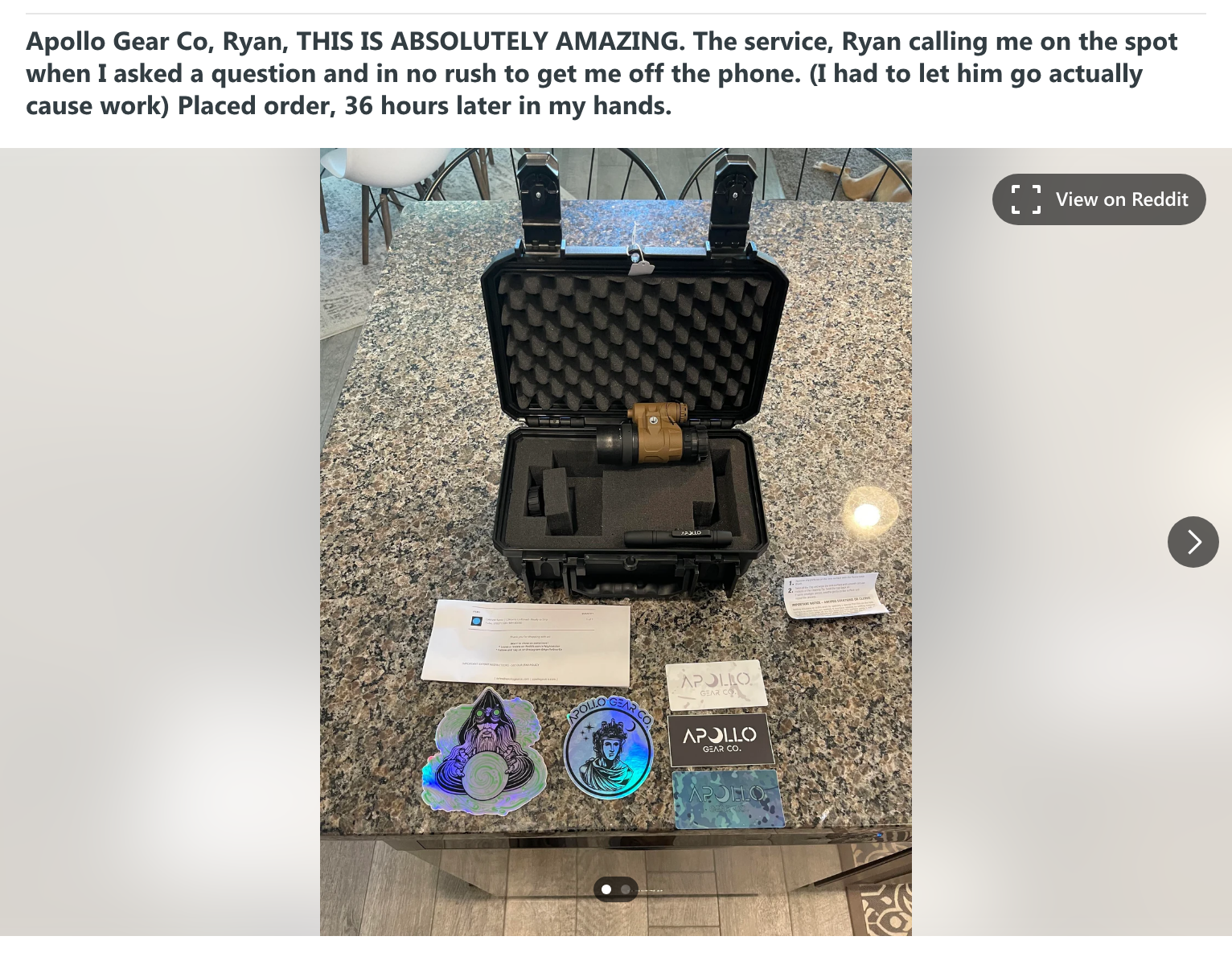
An early customer found Apollo through Reddit. I built a custom package around his purchase, included an aperture attachment I had fabricated, shipped it quickly, and remained available when he had questions. He later wrote a detailed post about the experience for the community. It generated calls and additional orders.
That became the early growth loop. Customers introduced me to other buyers, suppliers, former military colleagues, and adjacent businesses. Apollo’s reputation accumulated one interaction at a time.
 Expand
A manufacturing partner initially produced private-label devices for Apollo. The arrangement let me test demand before investing in a facility and specialized equipment. I ordered in small batches, monitored sell-through, and placed the next order before the current batch was gone.
As the business grew, the partnership no longer provided the control or differentiation Apollo needed. Supplier access broadened across the market, Apollo’s law-enforcement work increased, and product consistency became harder to manage. The partner had helped validate the business; the next constraint was quality control.
Direct sourcing and in-house manufacturing
Bringing manufacturing and quality control in-house
I decided to build Apollo’s manufacturing capability only after demand justified the investment.
That required a dedicated facility, a clean working environment, nitrogen purging, air filtration, specialized testing and collimation equipment, component relationships, and enough capital to absorb supplier lead times measured in months.
I established a direct relationship with a major U.S. intensifier-tube manufacturer by approaching the conversation with a concrete purchasing commitment. That relationship gave Apollo direct access to a critical component and a custom high-performance specification.
I learned the manufacturing work through a combination of direct practice, supplier guidance, and systematic testing. Housing manufacturers explained their components. Hoffman Engineering helped me understand the test equipment. Repeated builds and field use turned instructions into judgment.
Designing the production system
As volume increased, I moved from building one device from start to finish to a staged production process. Incoming lenses and housings were inspected, tested, cleaned, lubricated, and stored in sealed containers. Intensifier tubes were photographed against a standard chart and tied to their serial numbers. Prepared components then moved through assembly, collimation, purging, configuration, and final testing in batches.
One repetitive step was imaging every intensifier tube for the website. A commercial imaging system cost roughly $15,000. I needed only one part of its function, so I rebuilt that workflow for about $500.
I modified a PVS-14 to make tube changes fast, fixed the optical distance so focus remained consistent, and used an iPhone application that locked focus, exposure, and white balance. It was a purpose-built tool for creating consistent, serial-linked product images rather than a replacement for the full test system.
Reading the market and selling the company
Over time, inventory took longer to sell, component costs rose, more dealers entered the category, and supplier quality became less consistent. I saw those changes as early signs of weaker discretionary demand. I increased Apollo’s focus on grant-funded law-enforcement buyers and began evaluating an exit while the company remained healthy.
One of Apollo’s wholesale customers operated a complementary business and became a logical buyer. I initiated the discussion, negotiated the transaction, sold down Apollo’s remaining inventory, and transferred the brand, website, supplier relationships, customer relationships, equipment, and operating knowledge.
I remained involved for several months to train the buyer, make introductions, and support the transition.
What the experience required
Apollo required me to move from market research and sales into supply-chain design, regulated operations, manufacturing, and transaction execution. Each capability followed from a constraint the business had reached.
The work established a pattern I have carried forward: learn the domain through direct work, locate the constraint, and take responsibility across functions.